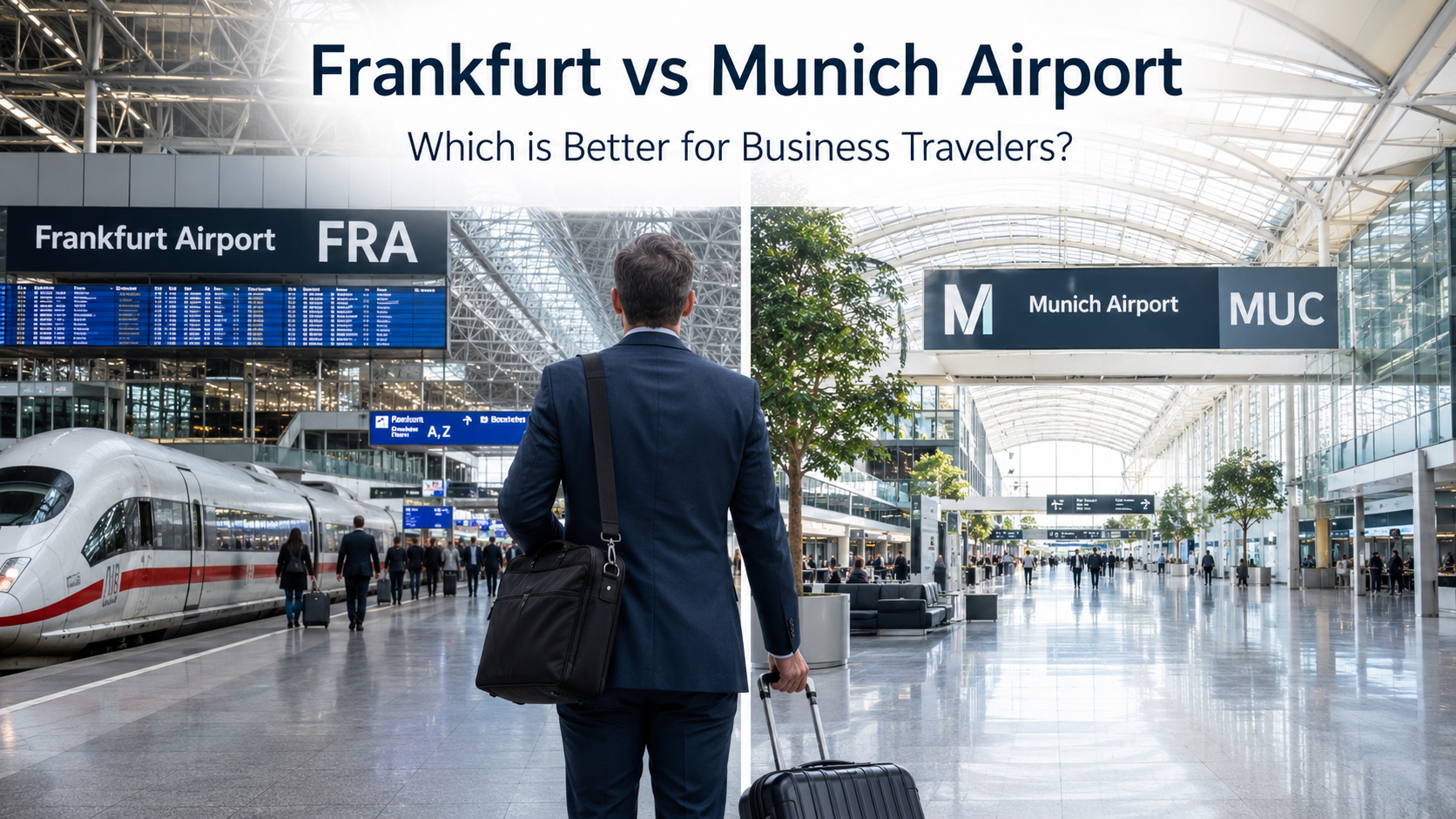
August 05, 2026 By LimoFahr
Germany has two airports that regularly compete for the title of the country's premier international aviation hub. Frankfurt Airport (IATA: FRA) and Munich Airport (IATA: MUC) both serve as major Lufthansa bases, both offer extensive intercontinental connectivity, and both connect to their respective city centres with efficient public transport.
But for a business traveler choosing between them, the differences matter. This guide compares FRA and MUC across eight dimensions to help you make the right decision for your next trip.
|
Dimension |
Frankfurt (FRA) |
Munich (MUC) |
|
IATA Code |
FRA |
MUC |
|
Annual Passengers (2025) |
63.2 million |
43.4 million |
|
Number of Terminals |
3 (as of April 2026) |
2 + Satellite |
|
Airlines |
94 |
96 |
|
Destinations |
300+ across 96 countries |
232 across 72 countries |
|
Distance to City Centre |
~12 km |
~29 km |
|
Train to City Centre |
~15-20 min (S8/S9) |
~35-40 min (S1/S8) |
|
Primary Hub Airline |
Lufthansa Group |
Lufthansa / Star Alliance |
Frankfurt Airport is Germany's largest airport by a significant margin. In 2025, FRA handled approximately 63.2 million passengers, a 2.6% increase on 2024. According to Fraport's official traffic statistics, the airport serves over 300 destinations across 96 countries, making it one of the busiest airports in Europe.
Munich Airport processed 43.4 million passengers in 2025, a 4.4% growth rate that made it the fastest-growing major airport in Germany. While smaller than Frankfurt, MUC has consistently ranked as one of Europe's most passenger-friendly airports and achieved strong long-haul growth of 8.5% in 2025.
For sheer scale and volume of connections, Frankfurt leads. But Munich's growth trajectory and strong quality ratings show it punching above its weight relative to its size.
Frankfurt Airport operates three terminals as of 2026:
● Terminal 1: The oldest and largest building, handling most Lufthansa Group flights and the majority of full-service carrier operations. It is connected to the airport's long-distance railway station (Fernbahnhof), from which ICE high-speed trains depart directly.
● Terminal 2: Traditionally served a broad mix of airlines. In 2026, 57 airlines transitioned from Terminal 2 to the new Terminal 3 in phased moves between April and June.
● Terminal 3: Inaugurated on April 22, 2026, with operational service beginning April 23. Initial capacity is 19 million passengers per year, with expansion potential to 25 million. Terminal 3 is connected to T1 and T2 by an automated people mover.
Frankfurt's scale means its terminals are large and distances between gates can be significant. For layovers and connections, allow adequate time to move between gates, particularly for connections requiring terminal changes.
Munich Airport operates two main terminals plus a Satellite building:
● Terminal 1: Handles all airlines except Lufthansa and Star Alliance partners. A new pier opened at Terminal 1 on April 21, 2026, adding capacity for up to 6 million additional non-Schengen international passengers annually.
● Terminal 2 and Satellite: A joint venture between Munich Airport and Lufthansa, serving Lufthansa, its subsidiaries, and all Star Alliance member airlines. T2 and the Satellite together have a combined capacity of approximately 36 million passengers annually.
The two terminals are connected by a free automated transit system. Munich's layout is generally considered more compact and easier to navigate than Frankfurt's, which is a meaningful advantage for travelers making quick connections or navigating for the first time.
Frankfurt Airport's connectivity is exceptional at the intercontinental level. It serves as the primary hub for the Lufthansa Group, which includes Lufthansa, Lufthansa CityLine, Discover Airlines, and Lufthansa Cargo. In the 2025/2026 winter schedule, 81 airlines operated from FRA to 244 destinations, with strength across North America, Asia Pacific, the Middle East, and Africa.
Munich Airport serves 232 destinations across 72 countries with 96 airlines. Its long-haul network is strong, with Lufthansa basing all eight of its Airbus A380 aircraft at MUC in 2025, demonstrating the airline's continued investment in Munich as a premium long-haul hub. Other carriers with significant MUC presence include Cathay Pacific, United Airlines, Etihad Airways, and EVA Air.
For raw destination count and global reach, Frankfurt has the edge. But Munich offers strong long-haul connectivity on its own right, particularly for travelers in southern Germany, Austria, and Switzerland.
This is one of the most practically significant differences between the two airports for business travelers.
Frankfurt Airport is approximately 12 kilometers from the heart of the city. The airport's railway station is directly integrated into the terminal, and the S-Bahn journey to Frankfurt Hauptbahnhof takes approximately 15 to 20 minutes. FRA also has a dedicated long-distance railway station (Fernbahnhof) where ICE trains depart for Cologne, Stuttgart, Hamburg, Berlin, and other German cities, making FRA a genuine European rail hub as well as an aviation one.
Munich Airport is located approximately 29 kilometers northeast of the city centre. The S-Bahn journey takes 35 to 40 minutes under normal conditions. There is no high-speed train connection between the airport and the city, though plans for a direct rail link have been discussed for many years.
For business travelers whose meetings are in or near the city centre and who value quick transit, Frankfurt's proximity and rail connection are a clear advantage.
S-Bahn (S8 and S9): The fastest public transport option. Both lines connect directly to Frankfurt Hauptbahnhof and central stations in approximately 15 to 20 minutes. Trains run every 15 minutes. Tickets must be purchased and validated before boarding.
ICE long-distance train: From the Fernbahnhof beneath Terminal 1, ICE services connect to major German cities including Cologne (approximately 1 hour), Stuttgart (approximately 1 hour), and Hamburg (approximately 4 hours). This makes FRA a highly efficient hub for domestic German business travel without requiring a separate journey into Frankfurt city centre.
Taxi: A metered taxi from FRA to Frankfurt city centre typically costs €30 to €40 and takes 20 to 30 minutes depending on traffic.
Private chauffeur: A pre-booked chauffeur transfer with meet and greet, fixed pricing, and flight monitoring typically ranges from €50 to €90 for a city centre delivery, depending on vehicle class and provider.
|
Transport Option |
Journey Time |
Approx. Cost |
Available 24 Hours |
|
S-Bahn (S8/S9) |
15-20 min |
~€5.50 |
No |
|
ICE Train |
Direct to other cities |
Varies |
Limited |
|
Taxi |
20-30 min |
€30-€40 |
Yes |
|
Private Chauffeur |
17-25 min |
€50-€90 |
Yes |
S-Bahn (S1 and S8): Both lines connect Munich Airport to the city centre, with a combined frequency of every 10 minutes. The journey to Munich Hauptbahnhof takes approximately 35 to 40 minutes. The S8 runs 24 hours on weekends.
Taxi: A metered taxi from MUC to Munich city centre typically costs €80 to €110, making it significantly more expensive than Frankfurt due to the greater distance.
Private chauffeur: Pre-booked chauffeur transfers from MUC to central Munich typically range from €70 to €150, depending on vehicle class and provider.
|
Transport Option |
Journey Time |
Approx. Cost |
Available 24 Hours |
|
S-Bahn (S1/S8) |
35-40 min |
€17.50 (day ticket) |
Partial (S8 on weekends) |
|
Taxi |
30-50 min |
€80-€110 |
Yes |
|
Private Chauffeur |
30-50 min |
€70-€150 |
Yes |
LimoFahr provides pre-booked chauffeur transfers from both Frankfurt Airport (FRA) and Munich Airport (MUC) with fixed pricing, flight monitoring, and meet and greet included. Book your Germany airport transfer with LimoFahr.
Frankfurt Airport has an extensive lounge infrastructure reflecting its role as Germany's largest hub. Key options include:
● Lufthansa Senator Lounge and Business Lounge (multiple locations in T1 and T2)
● Lufthansa First Class Lounge and Terminal (exclusively for Lufthansa First Class and HON Circle members)
● Star Alliance Lounge in T1
● Various pay-per-visit lounges accessible via credit card membership or purchase
Munich Airport also offers strong lounge coverage, including:
● Lufthansa Business Lounge near Gate G (T2)
● Lufthansa Senator and HON Circle Lounge (T2, with separate First Class Terminal for eligible passengers)
● Star Alliance Lounge (T2)
● OSL-style general access lounges in T1 available for purchase
Munich's Terminal 2 lounge environment is frequently cited by frequent business travelers as more relaxed and less crowded than Frankfurt's equivalent facilities, particularly during peak times. Frankfurt's sheer volume of passengers can make popular lounges busy during morning and evening waves.
For a short connection (under 2 hours), Munich Airport generally offers a more forgiving environment. Its more compact layout reduces walking distances, the terminal is easier to navigate for first-time visitors, and security and passport control queues are typically shorter.
Frankfurt's larger size and higher passenger volumes mean that minimum connection times are longer. Fraport recommends minimum connection times of 45 minutes for domestic-to-domestic connections and 60 to 90 minutes for international connections, depending on the terminal combination. For T1 to T3 connections, additional time should be allowed.
For a longer layover (4 hours or more), Frankfurt's direct city rail connection is a significant advantage. Traveling into the city centre, taking a meeting or visiting a client, and returning to the airport is practical from FRA in a way that is harder to achieve from MUC given the longer journey time.
There is no single right answer. The choice between Frankfurt and Munich depends on your specific travel circumstances.
Choose Frankfurt (FRA) if:
● You need the widest possible selection of direct long-haul routes and connections
● Your final destination in Germany is Frankfurt itself or a city on the ICE high-speed rail network (Cologne, Stuttgart, Hamburg, etc.)
● You have a longer layover and want to use the time productively with a quick city visit
● You are connecting onward across the Lufthansa Group's full long-haul network
Choose Munich (MUC) if:
● Your meetings or hotel are in Munich
● You are traveling onward to Austria, Switzerland, or southern/eastern Europe
● You prefer a smaller, more manageable airport environment with shorter walking distances
● You are flying with Lufthansa on a long-haul route and want the dedicated MUC Lufthansa premium experience, which includes the A380 fleet
● You value shorter queues and a calmer lounge environment
Both airports are well-run, professionally staffed, and capable of handling the full range of international business travel requirements. For most business travelers, the destination city will be the deciding factor. When the choice is genuinely open, Frankfurt's global connectivity and rail integration give it a slight edge for pure transit utility, while Munich offers a more pleasant day-to-day airport experience at a more manageable scale.
Frankfurt Airport is significantly larger. In 2025, FRA handled approximately 63.2 million passengers compared to Munich's 43.4 million. Frankfurt also has more terminals (three as of 2026, following the opening of Terminal 3 in April 2026) and serves over 300 destinations across 96 countries, compared to Munich's 232 destinations across 72 countries. By most measures of scale, Frankfurt is Germany's largest airport.
Frankfurt Airport offers more international connections by destination count and airline number. FRA connects to over 300 destinations across 96 countries with 94 airlines and is particularly strong for intercontinental routes to North America, Asia Pacific, and the Middle East. Munich offers 232 destinations with 96 airlines and has a strong long-haul program including dedicated Lufthansa A380 services, but Frankfurt's global network is broader overall.
Munich Airport is generally considered easier to navigate for a short layover. Its two-terminal layout is more compact, walking distances are shorter, and the airport is easier to orient for first-time visitors. Frankfurt's three terminals and higher passenger volume mean longer minimum connection times, particularly for connections involving the new Terminal 3. For layovers under 2 hours, Munich's layout is more forgiving.
Both cities offer strong business infrastructure, but the right choice depends on your industry and meeting location. Frankfurt is Germany's financial capital, home to the European Central Bank and a major concentration of banking, finance, and professional services firms. The 12 km proximity and direct S-Bahn link make it practical to transit into the city for a meeting even during a layover. Munich is Germany's technology and manufacturing hub, home to BMW, Siemens, and a growing tech sector, with a high quality of life that makes it popular for longer business visits. The 29 km distance from the airport means city trips require more planning around the transfer time.
August 13, 2026 By LimoFahr
Japan is one of the world's most rewarding destinations for business and leisure travel. It is also one of the most rewarding for ground transport. Trains are excellent, punctuality is a cultural standard, and the service quality of professional chau...
READ MORE
August 05, 2026 By LimoFahr
Germany has two airports that regularly compete for the title of the country's premier international aviation hub. Frankfurt Airport (IATA: FRA) and Munich Airport (IATA: MUC) both serve as major Lufthansa bases, both offer extensive intercontinental...
READ MOREguide2026.png "Oslo Airport (OSL) Guide 2026: Terminals, Lounges and Transport")
July 30, 2026 By LimoFahr
Oslo Airport Gardermoen (IATA: OSL) is Norway's main international airport and one of Scandinavia's busiest aviation hubs. Located approximately 47 kilometers north of Oslo city centre, it serves over 27 million passengers per year and connects the N...
READ MORE
July 16, 2026 By LimoFahr
Berlin Brandenburg Airport (IATA: BER) is the main international gateway into Germany's capital, handling millions of passengers each year across two active terminals. Whether you are flying in for a business meeting, transiting through Berlin, or de...
READ MORE
July 03, 2026 By LimoFahr
Traveling alone as a woman takes planning, confidence, and the right choices along the way. One of those choices is how you move between airports, hotels, and destinations, particularly in cities you are visiting for the first time. This guide explai...
READ MORE
June 22, 2026 By LimoFahr
If you travel regularly for work, you have probably weighed the options: book a chauffeur, open Uber, or find a taxi rank. On the surface, the choice looks simple. But the actual cost of each option for business travel goes well beyond the base fare....
READ MORE
August 31, 2026 By LimoFahr
August 24, 2026 By LimoFahr
August 20, 2026 By LimoFahr
August 13, 2026 By LimoFahr
August 05, 2026 By LimoFahr
Hourly bookings have a few rules that passengers should be aware of. When booking a trip on an hourly basis, it typically starts at the time you meet the driver, within the included waiting time. The trip ends in the area of the city where you indicated your pickup point.
For Economy+ or Business booking class, there is an included waiting time of 15 minutes for pickups outside of the airport, and 45 minutes for Economy+ airport pickups, 60 minutes for Business airport pickups. For First Class, the included waiting time is 30 minutes for pickups outside of the airport and 90 minutes for airport pickups. It's worth noting that hourly bookings are only for a certain amount of time and include specified pickup location, toll, and parking fees are not included in the price.
Saves Time! Travelling to new city for business meetings and you need to get there on time. Scheduling or pre-booking a taxi will benefit you in many cases as taxi will be available at the airport as you reach there, you don’t have to stand in queue and hail for taxis. You don’t know if the taxi is safe or not if you are not pre-booking. You can check our service on our website and go through our fleet and choose taxi as per your choice. You can adjust your trip according to yourself!
An airport transfer is a ride from the airport after your plane lands. The company will ask for your flight number during the booking process so the driver can be there at the time of your plane's arrival. Please note that flights are not tracked for rides to the airport. If you need to be dropped off at a specific terminal, please include it in the destination/drop-off address. What if I provide the incorrect flight number and want to change it? You can change the flight number for free in your account until 3 hours before the scheduled pickup time.
For limousine bookings, the driver will typically be holding a pickup sign with your name and surname on it. You can also request specific text to appear on the sign when making your booking. Simply look for the sign upon arrival at the airport.
For Quality Taxi bookings, the details of your car, along with the driver's contact information will be sent to you via SMS before your pickup.
If you have difficulty finding your driver for either type of booking, you can always call them using the mobile number provided in the SMS sent to you by the company.
Well, these services are designed to get you to your destination quickly and comfortably, without having to worry about the stress of driving yourself or dealing with public transportation. We are there to make all the difference while you can care a little less about all the planning. We bet guaranteed satisfaction along with the best chauffeurs who will guide you throughout the journey and offer an explicit helping hand in order to match the level of comfort you desire. Our motto is to meet all customers needs and create an unforgettable experience for them which they can cherish for life. We believe in creating experiences and thus all our staff is very welcoming and friendly, we offer utmost every kind of help and support in order to comfort you while you travel or stay here. You can always trust us with your travel related concerns and connect with our team if need be and we will sort it out for you..
Searching for your ride…
Comparing prices from our partners. This can take a few seconds.